The Evolution of Music Consumption: From Vinyl to Streaming and What’s Next for Artists
Music consumption has evolved from physical ownership to unlimited access, reshaping how artists create, release, and connect with audiences. This piece reflects on those shifts and asks a central question for creators today… what comes next?
Andre "Dre" Marshall
2/24/20263 min read
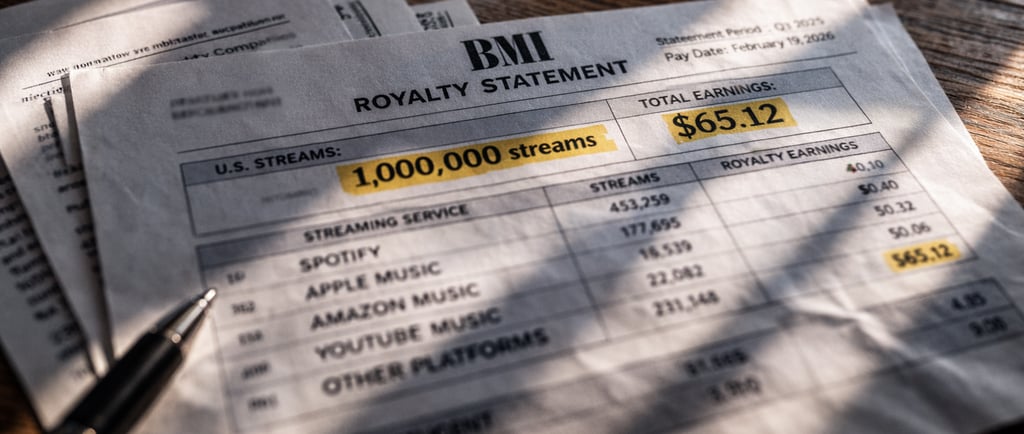
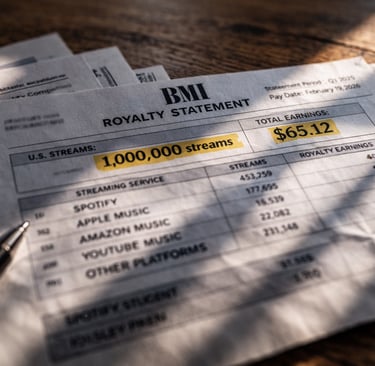
A client of mine recently crossed a milestone… over a million streams on a record. The kind of number artists screenshot, celebrate, and post with gratitude because on the surface it looks like success.
Then the payout hit. Roughly sixty-five dollars. That moment summed up the current music economy better than any statistic ever could.
Exposure is up. Access is up. Creation is easier than it has ever been. Yet the value of the music itself feels diluted.
It makes you pause and ask a bigger question… how did we get here, and more importantly, where do we go next?
Music consumption has always evolved alongside technology, and every shift has reshaped fan behavior and artist income.
In the vinyl era, music felt intentional. You owned something physical, studied the artwork, read liner notes, and experienced albums from beginning to end. Scarcity worked in the artist’s favor. If you wanted the music, you had to purchase it.
Cassettes introduced portability and personalization, giving rise to mixtape culture. CDs followed with clarity and durability, eventually pushing the industry to its revenue peak in the late nineties. Then MP3s disrupted everything by breaking the album bundle.
A single song could live on a hard drive and move anywhere, setting the stage for streaming to complete the shift from ownership to access.
Streaming didn’t kill music. It killed scarcity.
Friction disappeared. Listeners gained unlimited discovery. Artists gained global reach. The tradeoff came in per-unit value, where a million streams can feel culturally significant while paying very little financially.
Another layer often gets overlooked.
For decades, access to the industry was limited by expensive studios, specialized engineers, manufacturing costs, and distribution pipelines controlled by labels. Gatekeepers restricted entry while capturing most of the revenue.
Today those barriers are largely gone. Home studios rival professional spaces from the past, and distribution platforms allow artists to release globally with a few clicks.
Creation has been democratized. Money remains concentrated.
A small percentage of artists and major label catalogs generate most streaming revenue while millions of songs compete for finite listener attention. The industry didn’t become less competitive when tools became cheaper. It became more competitive because attention replaced distribution as the scarce resource.
This creates a strange reality.
Artists have more freedom and ownership than ever while facing less predictable income from recordings alone. Independence is empowering, but it demands strategy, marketing skill, and infrastructure. Releasing music is no longer the finish line. It’s the starting point.
Tangible formats reflect this shift.
Vinyl never disappeared, but its role changed from everyday listening medium to collectible artifact, a symbol of deeper fan connection. Few listeners want to return to binders of CDs, yet they still crave ownership moments that feel personal and meaningful.
Tangible today is less about convenience and more about identity and experience.
The future likely isn’t about going backward but about coexistence.
Fans stream daily because convenience is unmatched… while purchasing occasionally when the connection feels strong. Artists who understand this dual behavior are better positioned.
Streaming functions as exposure infrastructure. Ownership-driven products and experiences function as income infrastructure.
For artists, the path forward isn’t fighting streaming but building around it… through publishing, neighboring rights, sync licensing, direct fan relationships, limited physical releases, live experiences, and community-based models that transform music into a long-term catalog asset rather than a short-term release cycle.
Looking at the evolution of formats reveals a clear pattern. Every shift gives fans something new while requiring artists to adapt.
Vinyl offered ownership. Cassettes offered portability. CDs offered quality. MP3s offered convenience. Streaming offered access.
The next chapter may center on value, connection, and sustainability.
A million streams can represent reach and discovery. The challenge now is ensuring cultural success translates into economic stability for creators.
We’ve moved beyond the era of gatekeepers and physical scarcity. The tools are in the hands of artists.
The question is no longer how to release music.
It’s how to build value around it… and where the industry chooses to go next.